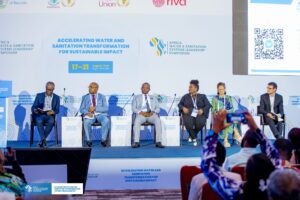
The hardest partnership in government reform is often the one inside government. And whether that partnership works can fundamentally determine whether a solution scales or succeeds at all.
The development sector is used to multi-actor programs. Philanthropy, NGOs, technical partners, implementers and multilaterals work alongside government institutions to design and deliver pilot programs for social development, usually with the same end goal in mind: a public sector willing and able to adopt a mechanism that works and carry it forward with its own resources and reach.
Because of that, conversations about these initiatives tend to focus on the actors outside the government. How should an NGO approach a ministry. What a technical partner’s role should be during design. What it takes for a pilot to earn government buy-in and eventually scale into a government-owned program. Partnerships get analyzed, almost by default, with a cross-actor focus: government on one side of the table, everyone else on the other. That framing misses a key element of what is actually at stake.
This year Instiglio was represented by Siegrid Holler, Managing Partner and Chief Impact Officer, and Nicole Pflock, Director at the Social Outcomes Conference, hosted by the Government Outcomes Lab (GO Lab). Across several sessions, both surfaced different areas of the same topic: how organizations can work with governments. Siegrid spoke about what it takes for institutions to shift their model responses to new approaches, while Nicole focused on how these mechanisms can be institutionalized, and the importance of partnerships within government in determining whether they can truly scale.
Before Cross-Sector Partnership: Alignment inside Government
The importance of building partnerships within government relies on the nature of its operation. The problems they are trying to solve sit across ministries, departments, and levels of government. However, the budgets, incentives, data systems, and accountability lines sit inside each institution separately. A ministry or secretariat can rarely resolve a cross-cutting problem alone, but the system doesn’t incentivize for other entities to help.
Although outcomes-based budgeting can help address this need, as one of the few practices that seeks to unite institutions behind a shared result rather than a shared department, almost nobody funds the capability to partner in the first place. Reforms get funded, and programs do too, yet the long-term capacity of institutions to coordinate with one another rarely does.
Nicole explained this at the Big Picture Session: “The mundane messiness of partnerships for impact: leading and navigating complex systems for impact at scale.” She was joined by Natalia Martínez Pardo, Director of Population Affairs at Bogotá’s District Secretariat for Social Integration (SDIS) and a champion of the Government Empowerment Network (GEN). She brought an on-the-ground government perspective to the conversation, explaining the how partnership barriers and opportunities within government institutions are lived on the day to day.
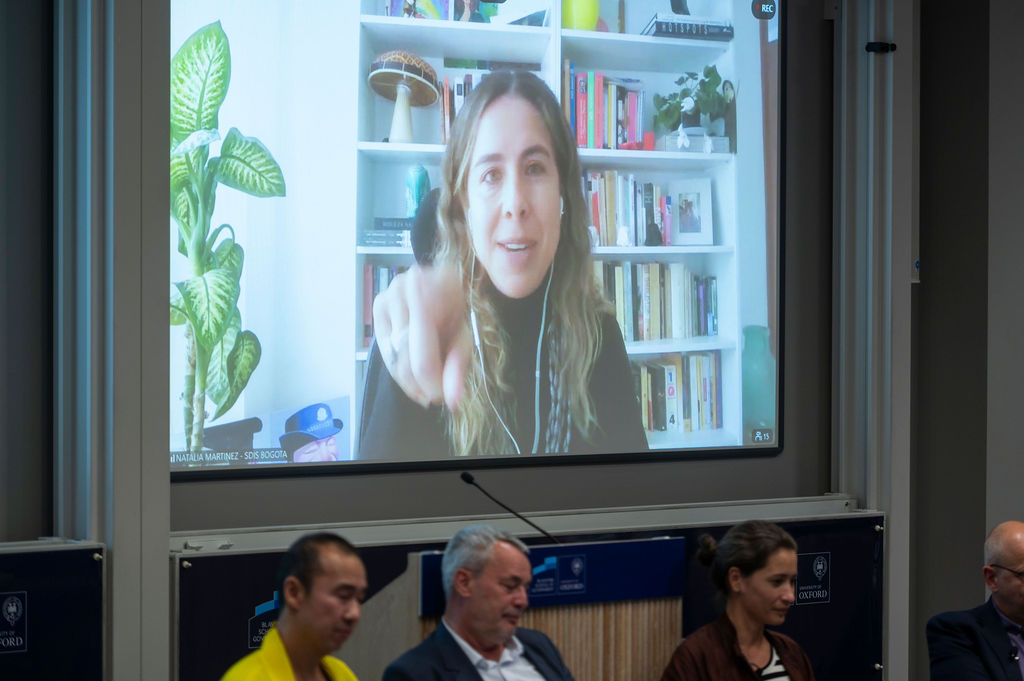
When asked by the chair about power imbalances between her own Secretariat and others in Bogotá’s government, Natalia described how her team approaches it:
“Every time we set up a partnership, we’re the big ones. Most of the time, other institutions feel that the Secretariat of Integration comes in first. We should take a step back and consider a different starting point: there are not two teams from different institutions. There is one government team with different roles.”
This reframing, one team instead of two competing institutions, is not a soft aside but a mechanism. When two government bodies stop negotiating as counterparts and start operating as one team with different roles, it creates space for people to ask for help without it being read as a failure, and to admit mistakes without them becoming a liability. In his closing remarks at the conference, the Dean of the Blavatnik School identified this as the theme he took from the entire session: how difficult it is for governments to build partnerships, even within government, and how much of what unlocks that difficulty is not contractual.
This has a direct implication for anyone funding or supporting government reform from the outside. The opportunity for funders is not to build alternatives to government, or even to design the cleanest possible cross-sector agreement. It is to strengthen the conditions that allow public systems to perform. Those conditions are not tied to technical capacity alone; they also depend on the incentives and accountability between institutions, as well as the relational infrastructure that allows the work to flow across them. Put simply: state capacity begins where public entities meet, and the partnership work that matters most is often the work no external partner sees.
Why Even a Well-Designed Partnership Stalls Without This
During the workshop “From Test Kitchen to Public Systems: The Recipe(s) for Scalable and Accountable Cross-Sector Partnerships,” Nicole also spoke about partnerships with governments, this time touching on what makes cross-sector, outcomes-oriented partnerships scale in the first place, drawing from Instiglio’s latest report written with Spring Impact and LGT Venture Philanthropy.
Just as mentioned before, a strong, evidence-backed solution does not determine whether government will adopt it. Three conditions have to line up at the same time. Politically, the reform needs a real decision-maker with actual authority behind it. Financially, government needs a legal, repeatable way to pay for it within its own budget rules, not simply the ability to afford it once. And on delivery, there needs to be an existing system, staff, and supervision that can actually carry it forward. None of these three gates are things an external partner controls.
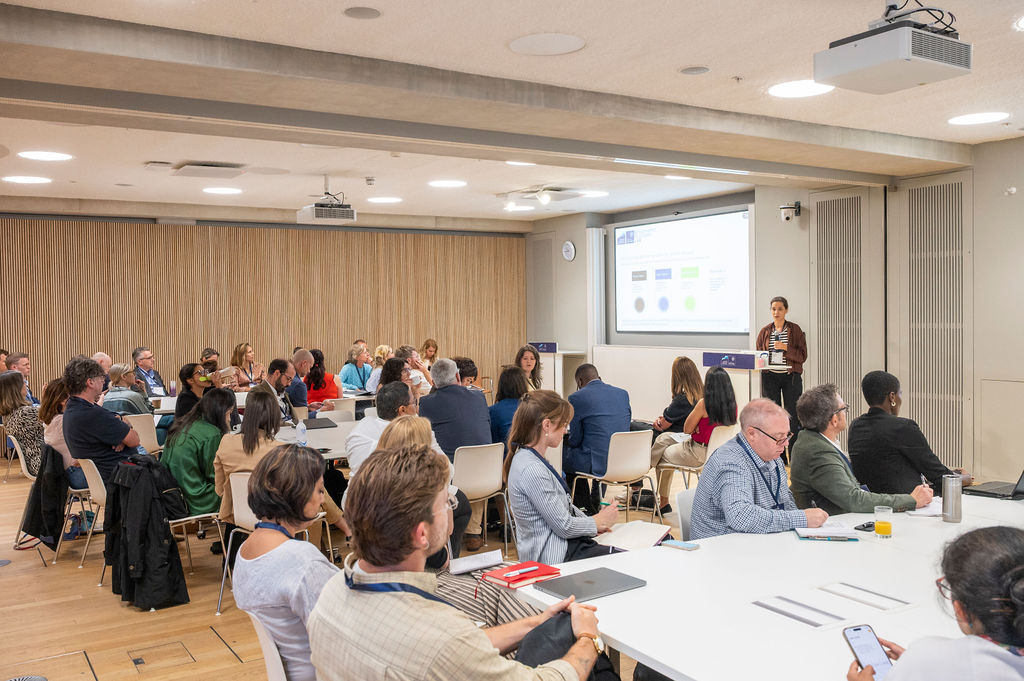
Underneath that is a sharper point: government officials weigh risk before they weigh results. Backing an outside solution is a personal and political risk for the official making that call, not only a technical judgment. The nonprofits in the study who scaled successfully treated that risk seriously. They worked inside existing government hierarchies rather than around them, added capacity instead of replacing it, and stayed quiet when something went wrong rather than making it public. One finding stood out as a useful signal for anyone reading government’s reaction to a proposal: when officials raise real disagreement and want to change the design, that is a stronger sign of genuine buy-in than polite agreement ever is.
As one Ugandan permanent secretary put it to Nicole’s team: government is not a vehicle for an outside solution to scale. Government is trying to solve its own problem. The role available to an external partner is not to hand over a finished model, but to bring expertise into a process that government still owns, and to stay open to the solution changing substantially along the way. Of the twelve cases studied in the report, only one scaled with its original design intact.
These insights answer to the Big Picture session’s claim, seen from the outside in. If the partnership inside government is not functioning, an external partner cannot design around it with a better MoU or a more generous grant. The precondition holds regardless of which side of the relationship is doing the work.
What This Looks Like in Practice: Bogotá’s Early Childhood System
In practice, Instiglio’s work on early childhood development (ECD) with Bogotá’s Secretariat for Social Integration illustrates what these claims look like on the ground. Insights from Siegrid and Santiago Ospina, who manages the work on the ground, help bring this experience to life.
Instiglio’s role in Bogotá is deliberately not to fund or manage these programs. Instead, we provide technical assistance, co-designing mechanisms with government and building the capabilities government needs to run them. The partnership spans three connected pieces. The first is a results-based financing (RBF) pilot with childcare centers, in which 12 of 35 centers voluntarily opted in to receive a performance bonus tied to continuous attendance and pedagogical quality, on top of their existing base contract. The second, the Creciendo Juntos program, supports caregivers of young children through home visits and group sessions. The third is a delivery unit built inside the Secretariat itself, an institutional engine that turns what the pilots learn into the Secretariat’s day-to-day routines and indicators, rather than leaving that learning trapped inside a time-bound project.
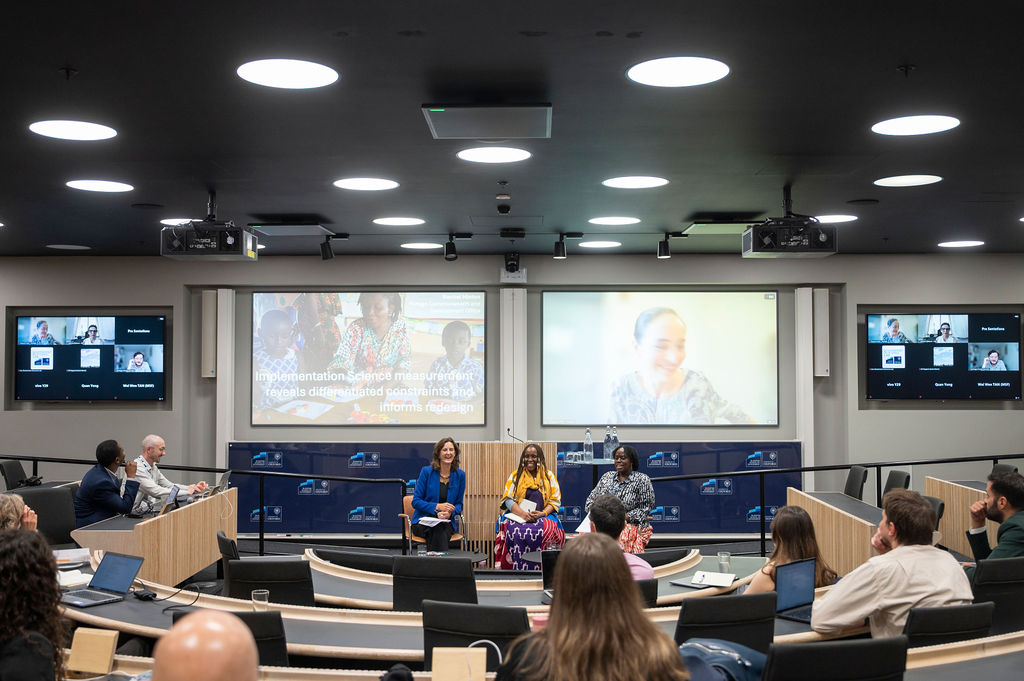
Two moments from this work show evidence-driven redesign in action. When the Secretariat surveyed caregivers under Creciendo Juntos, it found that 68% earned less than $500 a month; 82% spent more than eight hours a day on childcare, and nearly all wanted to work but could not because of caregiving responsibilities. The program was redesigned around two co-equal outcomes as a result: child development and caregiver economic autonomy, rather than child development alone. Treating child-focused and caregiver-focused interventions as genuinely different programs, allows different implementers with different expertise to nurture the proram, rather than folding every ambition into a single intervention.
The second moment came from the RBF pilot itself. Not every participating center earned its quality bonus in the first iteration; most scored in the medium range on pedagogy and low on learning environments. This means the mechanism has been working as intended, not failing. The response was not to scrap the bonus, but to redesign the program to also help providers improve, alongside paying for results.
None of this ran through a parallel system. The same district supervisors who already visited centers to check inputs now verify results as well, and the delivery unit sits within the Secretariat’s own structure, staffed and run by government. Philanthropic funding from the Hilton Foundation and UBS Optimus Foundation supported the design and learning; the programs themselves are entirely publicly funded, by design, because that is what makes the reform sustainable rather than dependent on continued donor support. In that sense, the hard work of aligning incentives, data, and accountability between the Secretariat and the centers, caregivers, and units it works with happened first, within government. The cross-sector partnership with Instiglio and its funders was possible because that internal work was already underway.
The Throughline
Across all three sessions, the same claim emerges from a different vantage point. Nicole named it directly: the hardest partnership in government reform is often the one inside government, not the one across sectors. The workshop showed why external partners who overlook that reality can end up designing partnerships that cannot hold, however well-intentioned. And Bogotá showed what it looks like when a government deliberately builds that internal alignment: an institutional engine that keeps learning, evidence that gets acted on rather than filed away, and a partnership with an external technical partner that strengthens the system instead of standing in for it.
For funders, NGOs, and technical partners working alongside governments, the implication is a shift in where to look first. Before asking which cross-sector partner to bring in or which solution to fund, a more useful question is whether the institutions on the government side are already able to work with one another. That is not a precondition an external partner can build on its own. It is, however, a precondition worth funding, designing for, and asking about before the cross-sector partnership is signed.