Designing Outcomes-Based Financing: Lessons from Sierra Leone and Bogotá

By: Tejaswini Mani, Valeria Ramírez Contreras, and Carolina Laguna Results-based financing (RBF) refers to a broad family of mechanisms that link payments to verified results. These results may be outputs or outcomes. Outcomes-based financing (OBF) is a form of RBF in which payments are tied, at least in part, to pre-defined outcomes rather than to […]
Partnerships Inside Government: The Precondition to Impact Scaling

The hardest partnership in government reform is often the one inside government. And whether that partnership works can fundamentally determine whether a solution scales or succeeds at all. The development sector is used to multi-actor programs. Philanthropy, NGOs, technical partners, implementers and multilaterals work alongside government institutions to design and deliver pilot programs for social […]
Beyond Community Management: What It Takes to Sustain Rural Water Services at Scale
Rural water systems in Ghana and Uganda show that community-managed infrastructure, however well built at the outset, is not designed to deliver cost-effective rural water services at scale. Handpumps and small piped systems that rely on volunteer caretakers and ad hoc tariff collection tend to fall into disrepair once construction ends and donor attention moves […]
Reimagining State Capacity for the Future of Development

On July 31, 2026, the Future of Development Cooperation Coalition convened its inaugural thematic workshop: Building State Capacities. Hosted by the African Center for Economic Transformation (ACET) and the Center for Global Development (CGD), the dialogue was guided by co-chairs Yemi Osinbajo, former Vice President of Nigeria, and Arancha González, former Foreign Minister of Spain. […]
What Uganda Is Learning About Clustering Districts for Rural Water Systems – One Water Service Area, Nine Districts
A rural water system can have a trained caretaker, a working handpump, and a management committee that meets every month, and still stop functioning within a few years. Infrastructure gaps are real, but they are rarely the only constraint. What determines whether a system keeps running is the economics behind it: whether the area generating […]
Strengthening Public Systems: What Philanthropy Must Fund to Make Government Delivery Work

A government entity can have skilled staff, adequate budgets, and a clear mandate — and still fail to deliver. Capacity gaps are real, but they are rarely the only constraint. What determines whether existing capacity turns into results is the surrounding architecture: whether incentives reward performance, whether accountability is built into how a system works, and whether institutional design […]
Instiglio at AfricaXchange 2026: Advancing African-Led Reform Through Government Systems

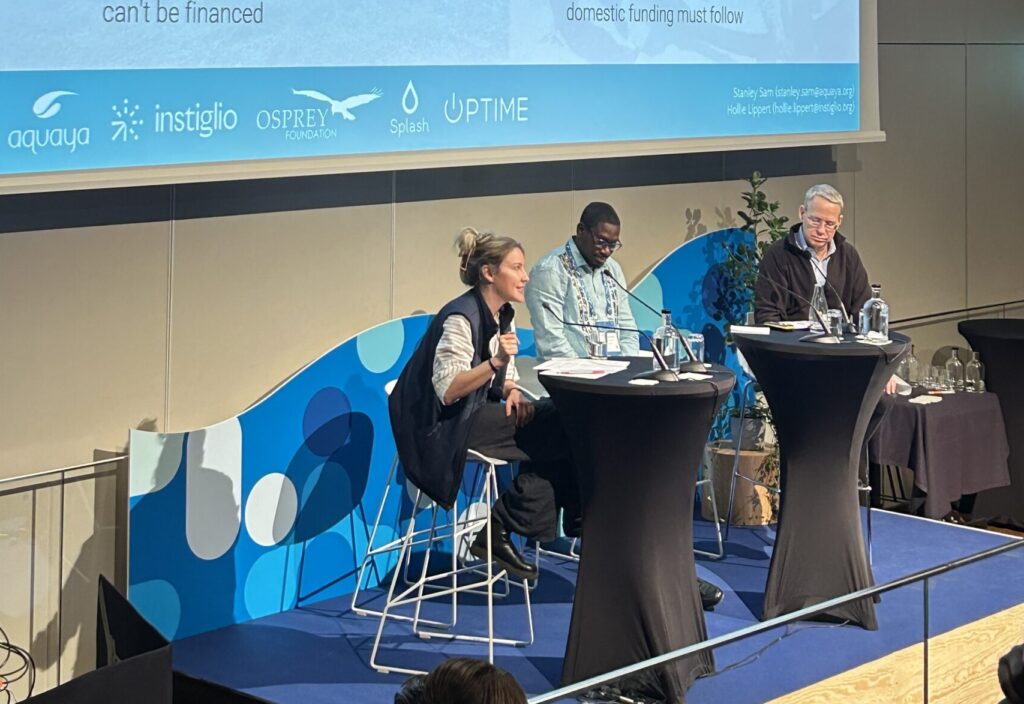
Instiglio joined government, philanthropy, and development finance leaders at AfricaXchange 2026 for an insightful discussion on what it takes to scale outcomes through public systems. Instiglio co-hosted a high-level round table with the Conrad N. Hilton Foundation at AfricaXchange 2026 titled “African-Led Reform in Practice: How Can Governments Scale Outcomes, and What Does This […]
Fundación Caricaco and Instiglio Launch an Alliance to Transform Youth Employment in Costa Rica

San José, Costa Rica. Fundación Caricaco, in alliance with Instiglio, announced the launch of the Alliance for Innovation in Public Youth Employment Programs. The initiative, supported by the Ministry of Labor and Social Security (MTSS), the Foreign Trade Promotion Agency of Costa Rica (PROCOMER), and the Citi Foundation, aims to strengthen public youth employment programs […]
For the ‘outcomes reflex’ to become a World Bank norm, incentives are key

Opinion: As the World Bank’s outcome-oriented approach takes hold, aligning incentives will ensure this shift is a durable one. Under President Ajay Banga, the World Bank Group launched a corporate scorecard and a year later created an outcomes department — a commitment to ensure that its roughly $90 billion in annual disbursements translate into meaningful impact. Yet even well-intentioned bureaucracies often […]