A rural water system can have a trained caretaker, a working handpump, and a management committee that meets every month, and still stop functioning within a few years. Infrastructure gaps are real, but they are rarely the only constraint. What determines whether a system keeps running is the economics behind it: whether the area generating revenue is large enough to support a professional operator, whether financing rewards verified results rather than inputs, and whether the service area is built at a scale that can actually cover its own costs. For funders and governments seeking rural water access that holds, that is where the design choices matter most.
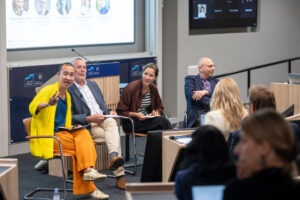
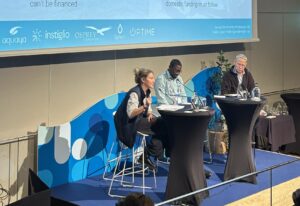
These aspects were discussed at the Africa Water and Sanitation Systems Leadership Symposium in Kigali, where Kipp Clarke, Senior Manager at Instiglio, and Tevin Rwamahe, Project Analyst, joined government leaders, innovators, and WASH partners to share insights from the Lango Water Alliance pilot seeking to bring sustainability at scale to Uganda’s rural water systems.

The Lango rural water pilot in northern Uganda, now clustering nine districts into one service area, brings together Uganda’s Ministry of Water and Environment (MWE), Uduma, and Uptime Global, who have partnered with Instiglio to design the results-based financing mechanism and the financial model that makes the project sustainable.
A Financing Gap: Uganda’s Rural Water Context
Since 1990, Uganda has pushed rural water access from around 25% to roughly 70% and has kept about 85% of systems running over the past decade. Although figures show significant progress, the system has also reached its ceiling. Community-based management, where a local committee owns the upkeep of a handpump, was never built to carry a national system this large. Today, an estimated 13.8 million rural Ugandans still live without reliable access to safe water, and the gap is not due to a construction problem, but a financing one. Underinvestment is valued at around USD 193 million a year in rural water operations and maintenance. That shortfall explains why 15% of rural water points sit broken at any given time.
In Uganda’s Lango sub-region, the gap is sharper still. Nationally, about 10% of people have piped water, while in Lango it goes down to 2%.
Clustering Nine Districts Into One Service Area
Instiglio designed the financing mechanism for a different model. Instead of asking each district to professionalize its own water services alone, nine districts in Lango have clustered into a single water service area, known as the Lango Water Alliance, allowing government to formally recognize them as one.
The logic of this results-based financing mechanism recognizes that no single Lango district generates enough revenue, or scale, to attract a professional operator on its own. Clustered together, the nine districts become a service area large enough to be bankable, covering more than 3,500 handpumps and 45 piped systems, with a gazetted area of about 1.8 million people, of whom roughly 950,000 will be served once the rollout is complete. The model is anchored in Uganda’s 2020 National Operation and Maintenance Framework and carries complete government ownership for its delivery since the project launched in October 2025.
The Lango model professionalizes the complete value chain. Under it, one professional operator, an Area Service Provider, holds two contracts: a service delivery contract and a results-based financing contract, with payment tied to verified results in reliability, water quality, and collection efficiency, instead of a fixed fee. Funding is disbursed against results rather than paid upfront for inputs, bridging the gap between operating costs and user revenue while keeping the operator accountable, without asking user fees alone to cover full cost recovery. Money follows performance, so that it rewards the behavior the system actually needs.

The clustering approach enables piped systems to cross-subsidize handpumps at scale. Piped systems, metered and billed, generate far more revenue per connection than handpumps do. Grouping nine districts into one service area lets that piped revenue support the handpumps that cannot cover their own costs and lets stronger sub-counties carry weaker ones. A mix of technologies, not handpumps alone, is what gives an operator a realistic path to financial viability. A pattern, operators in Benin and Zambia report as well: a handpump-only portfolio rarely reaches sustainability on its own. Growing the piped network, in other words, is not a separate goal from fixing the handpumps. It is the mechanism that pays for them.
Beyond all this, Uganda’s government agrees with these premises. At the symposium, a senior Ugandan water official reached the same conclusion the Lango design rests on: managing service district by district, across more than 140 districts nationally, does not work. Clustering is what lets professionalization run along the whole value chain.

Looking Ahead
Two questions remain open ahead of the tender: how tariffs should be set so they reflect cost fundamentals rather than affordability alone, and how asset condition should be assessed and allocated at handover so the operator is not left carrying renewal costs it never priced for. Neither is unique to Lango, and both need settling before the operator is procured. We will keep sharing what we learn as gazettement and contracting move forward.
Our thanks to Uganda’s Ministry of Water and Environment for leading this work, and to Uduma, Uptime Global, CEWAS, and the Conrad N. Hilton Foundation for their partnership. We are excited to keep building innovative solutions to improve water access for rural communities.