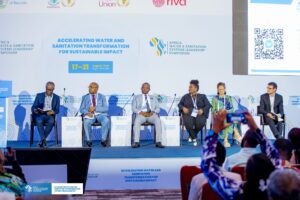
On July 31, 2026, the Future of Development Cooperation Coalition convened its inaugural thematic workshop: Building State Capacities.
Hosted by the African Center for Economic Transformation (ACET) and the Center for Global Development (CGD), the dialogue was guided by co-chairs Yemi Osinbajo, former Vice President of Nigeria, and Arancha González, former Foreign Minister of Spain. Instiglio’s co-founder and CEO, Avnish Gungadurdoss, joined the conversation as part of the Coalition, bringing a perspective grounded in Instiglio’s work partnering with public institutions to build government-owned public sector transformation.
The workshop’s primary objective was to address the main levers to build “state capacity,” the state’s ability to achieve policy goals, deliver services, and regulate markets. Participants argued that without a functional state machinery, capital alone cannot buy progress. This philosophy shifts the focus from external aid delivery to the internal structural engines that allow governments to chart their own destiny.

Why Traditional Capacity Building Often Fails
During the session, panelists highlighted the need for a fresh diagnosis, because decades of treating capacity as a “technical challenge” have failed to yield durable results. For too long, interventions focused narrowly on upskilling and digitalization, ignoring the reality that capacity gaps have deep political, relational, and structural roots. To bridge this gap, the Coalition synthesized five critical perspectives:
- Political Economy: Reform only persists when elite bargains shift from self-preservation toward a shared, growth-oriented future, as demonstrated historically in nations like China, Bangladesh, Ethiopia, and Indonesia.
- Implementation Capabilities: Governments often engage in “isomorphic mimicry,” copying the technical designs of foreign successes without the functional incentives or trust between citizens and bureaucrats required to make them work.
- Social Accountability: Capacity is a relationship. It is not just about the state’s ability to act, but its willingness to respond to citizen voices and provide dignity and agency.
- Decentralization: Formal rules often mask de facto realities. In many centralized systems, “street-level” bureaucrats exercise immense discretion, making local political competition a prerequisite for effective service delivery.
- Fragility: In contested settings, imposing “best-practice” institutions often creates parallel systems that drain local talent and resources rather than strengthening them.

Empowering Local Reform Coalitions
The Coalition advocated for a strategic shift from relying solely on “islands of excellence” (isolated, donor-funded units) to fostering broad-based domestic coalitions — noting that such pockets of excellence aren’t inherently bad, and can be a necessary starting point if designed for scale from the outset. As highlighted by Instiglio’s CEO, Avnish Gungadurdoss, mission-driven civil servants already exist within these systems; they are often simply waiting for the skills, political cover, and opportunity to act.
To make reform “politically irresistible,” development cooperation must help generate a “positive force field” composed of reform-minded leaders, civil society, and private sector leaders. The Coalition identified two primary levers for this shift:
- The Architecture of Alignment: Building systems of accountability, ministerial incentives, and transparent performance measures that make good governance visible to the public.
- The Celebration of Champions: Ensuring that those with “skin in the game” (the local leaders who live with the consequences of policy) receive the political credit and legitimacy needed to sustain their efforts.
Crucially, participants noted that “windows of opportunity” for reform are often short-lived and unpredictable. Thus, flexible, fast-moving funding is a structural necessity to help local reformers act when change becomes possible, moving beyond the systemic critiques of traditional aid.

A Structural Critique of International Aid
While much of the focus remains on the recipient state, the workshop turned a critical eye toward donors. Donor fragmentation (separate priorities, project units, and metrics) overwhelms the limited “attention budget” of local officials. Furthermore, rigid fiduciary standards often prioritize direct delivery through contractors and Project Management Units (PMUs), bypassing and inadvertently draining genuine local capability.
To address the “intellectual challenge of execution,” experts proposed a “Capacity Impact Test” for every major development program. Before approval, agencies would be required to answer:
- What existing government function does this strengthen?
- What reporting burden does it add?
- Will it pull civil servants away or distort local salaries?
- What authority and financing remain once the program ends?
The dialogue suggested a shift in the current aid logic to bridge the gap between ownership and results. Aid should go further, flowing only through actions that improve state capability, rather than the direct delivery of results.
This philosophy argues that delivering a project is not the same as delivering development. Success must be measured by the permanent increase in the state’s independent ability to function.
From Dialogue to Recommendations
The insights gathered here will directly inform the Coalition’s final report. Immediate next steps include the circulation of a two-page “electronic blackboard,” a synthesis designed to test these ideas with participants, and a dedicated session on fragility and conflict-affected states. These efforts will culminate in the high-level meeting in Accra this September, moving the global community from dialogue to actionable policy.
This is the work Instiglio’s own decade of experience partnering with public institutions demonstrates: helping governments build the capability to own and sustain their own reforms, rather than depend on external delivery. By shifting focus from the “top line” of budget allocation to the “bottom line” of implementation impact, development cooperation can finally help states build the enduring capacity required to chart their own futures.