Rural water systems in Ghana and Uganda show that community-managed infrastructure, however well built at the outset, is not designed to deliver cost-effective rural water services at scale. Handpumps and small piped systems that rely on volunteer caretakers and ad hoc tariff collection tend to fall into disrepair once construction ends and donor attention moves elsewhere. Water points that work well at commissioning can decline within a few years, leaving communities to cover repairs they were never resourced or organized to make.
Under specific conditions, Results-Based Financing (RBF) offers one way to close that gap. Instead of paying for infrastructure delivered, RBF ties funding to the outcome that infrastructure is built to produce: reliable water reaching people, every day. Instiglio’s work in Ghana with the District Last-Mile Water Trust and Uganda with the Lango Water Alliance points to four conditions that determine whether RBF actually shifts rural water systems toward professionalized delivery: i) Government must lead and co-invest; ii) Credible data and verification systems must be in place; iii) Public finance mechanisms must allow for outcome-based contracts; and iv) the operations and maintenance (O&M) viability gap, the difference between what tariffs can realistically cover and what reliable service actually costs, must be funded explicitly rather than assumed away. These are key conditions so that RBF pilots don’t risk becoming well-intentioned programs that cannot survive past donor funding.
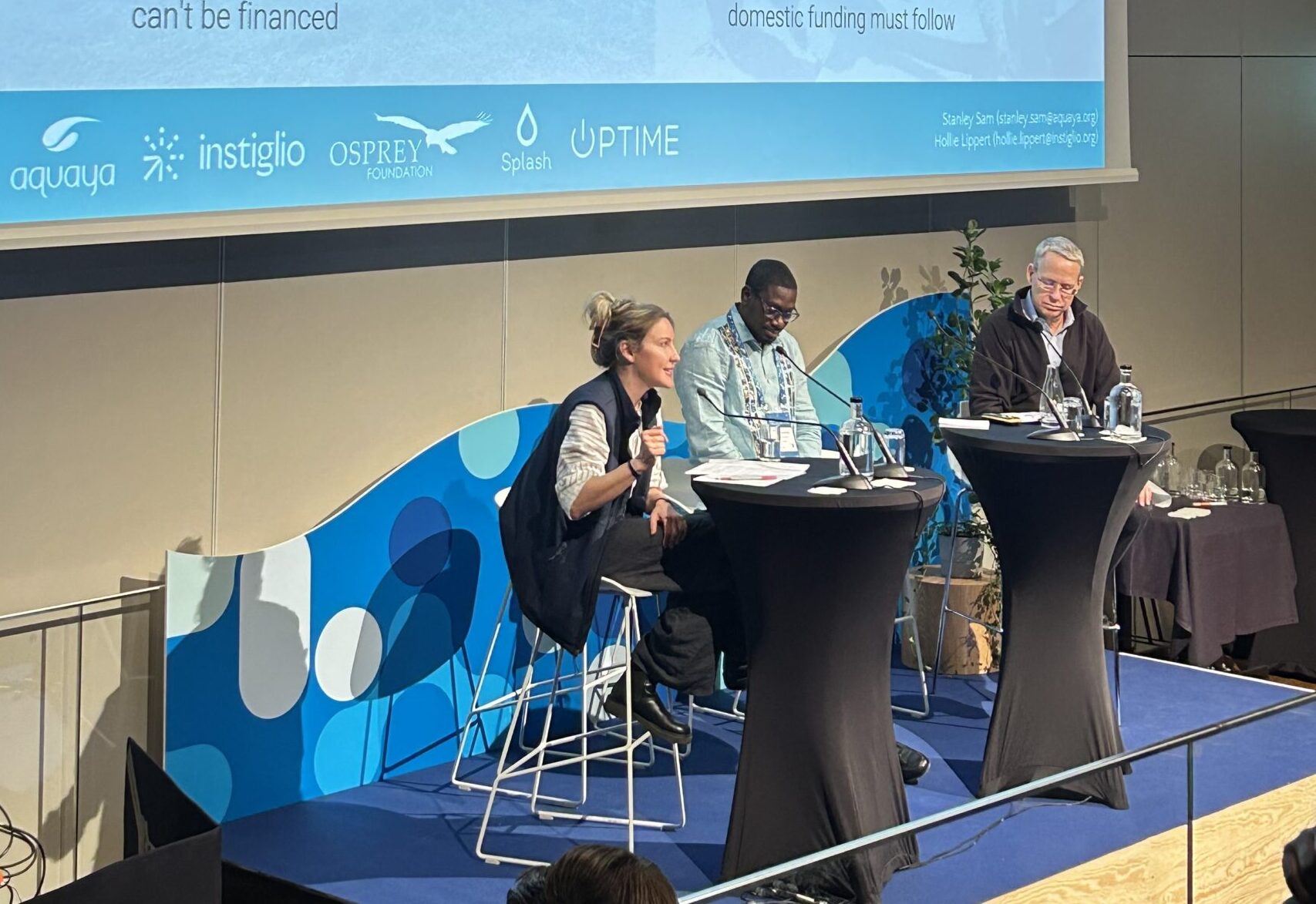
These findings were shared in the session Instiglio co-hosted at World Water Week 2026 in Stockholm, “Sustaining Public Drinking Water Services at Scale with Results-Based Funding.” Hollie Lippert, Director at Instiglio, co-hosted the session with partners from Aquaya, The Osprey Foundation, Splash International, and Uptime. She was joined by Brian Lang’at, Senior Associate, as representatives of Instiglio’s latest work in the water, sanitation, and hygiene (WASH) sector at the summit. The conversation brought together funders, governments, and WASH sector professionals to discuss how results-based approaches can move pilots from donor-funded initiatives to government-led programs.
Ghana and Uganda: Professionalizing Rural Water O&M
In Ghana, Instiglio’s work shows that the O&M viability gap can be measured and addressed directly. A major unresolved question, however, is who pays for the data collection and technical support that make that measurement possible once donor programs end.
In that aspect, Uganda has gone a step further. The government owns the design model of a rural water O&M framework built around professionalization and RBF. Its first test is the Lango pilot, where nine districts will jointly contract a single area service provider, covering approximately 1.8 million people, starting with roughly 100 handpumps. Aggregating districts in this way creates the scale needed for delivery, monitoring, and verification to work efficiently, while payments to the provider combine tariffs, viability-gap support, and incentives tied to reliability, revenue collection, and water quality. In this case, the pilot is donor-funded, with the explicit aim of generating evidence that can support government budget reallocation over time.
Colombia: What Government Ownership Can Look Like
To illustrate what this shift looks like once it takes hold, Hollie pointed to Colombia’s working for the employment sector. Colombia’s RBF journey began with a 2015 social impact bond that overdelivered to approximately 117% of its target.
As evidence accumulated through successive pilots, RBF began to scale: a dedicated outcomes fund, Logra, was created to address public finance constraints, while national policies and development plans increasingly provided explicit support for RBF. Over time, the government evolved from simply approving pilots to co-designing, funding, and directly managing programs, while the provider ecosystem expanded from roughly 16 organizations to nearly 60.
These cases exemplified a key insight Hollie drew for Ghana and Uganda’s WASH programs. RBF can provide the tools governments need to build the institutional conditions for it to scale if they are involved from the very beginning.
What Helps Secure Government Commitment
Having governments involved from the start of a project can be fundamental for pilots to be sustainable in the long run. This implies understanding its incentives, constraints, and political economy before designing a program and also seeking government co-funding at an early stage to avoid long-term dependence on external financing.
Then, the government should be involved as co-designers, rather than as approvers of a finished model. That said, flexibility is much needed as budget reforms can either mean reallocating existing funds or assigning new budget lines. Although the latter can take longer to secure, it can establish an important precedent.
Lastly, identifying and supporting government champions of the project can help drive it forward as they can carry the model forward from the inside.
With that, by building evidence gradually, through successive pilots, rather than expecting system-wide change immediately, governments can see evolution and adopt the measurement mechanisms for future system maintenance.
Turning Pilots Into Policy
What Ghana and Uganda are testing is more than a financing mechanism. It is a pathway for governments to move from hosting a pilot to owning it, the same shift Colombia’s employment programs made over a decade of scale-up. RBF gives governments the tools, credible data, and outcome-based contracts to make that shift deliberately rather than by accident. The Lango pilot and Ghana’s O&M work are early steps on that pathway, not its destination.
The real test ahead is not whether results-based financing works. It is whether governments are equipped and supported to lead it. We will continue to share what we learn as the Ghana and Uganda programs generate that evidence, and we welcome the conversation with organizations working through similar questions on financing rural water, sanitation, and hygiene services.